March 25, 2026


When to Start Puppy Training
Why Puppy Classes Have a Age Cut-Off | SmartyPup!
Puppy
m
Why Puppy Classes Have an Age Cut-Off | SmartyPup!
Puppy classes and socials are crucial to your dog's early development. However, these classes often have an age cut-off, typically around 16 weeks. Most pup-parents have no idea why.
Here’s the short and oversimplified answer: their mouth.
Yes, we care about manners and socialization and all the cute stuff. But underneath all of that is a simple reality: your puppy’s teeth and jaw are changing fast, and that has big consequences for how they play and how safe that play is for everyone else.
Mouthing: the link between teeth development and play
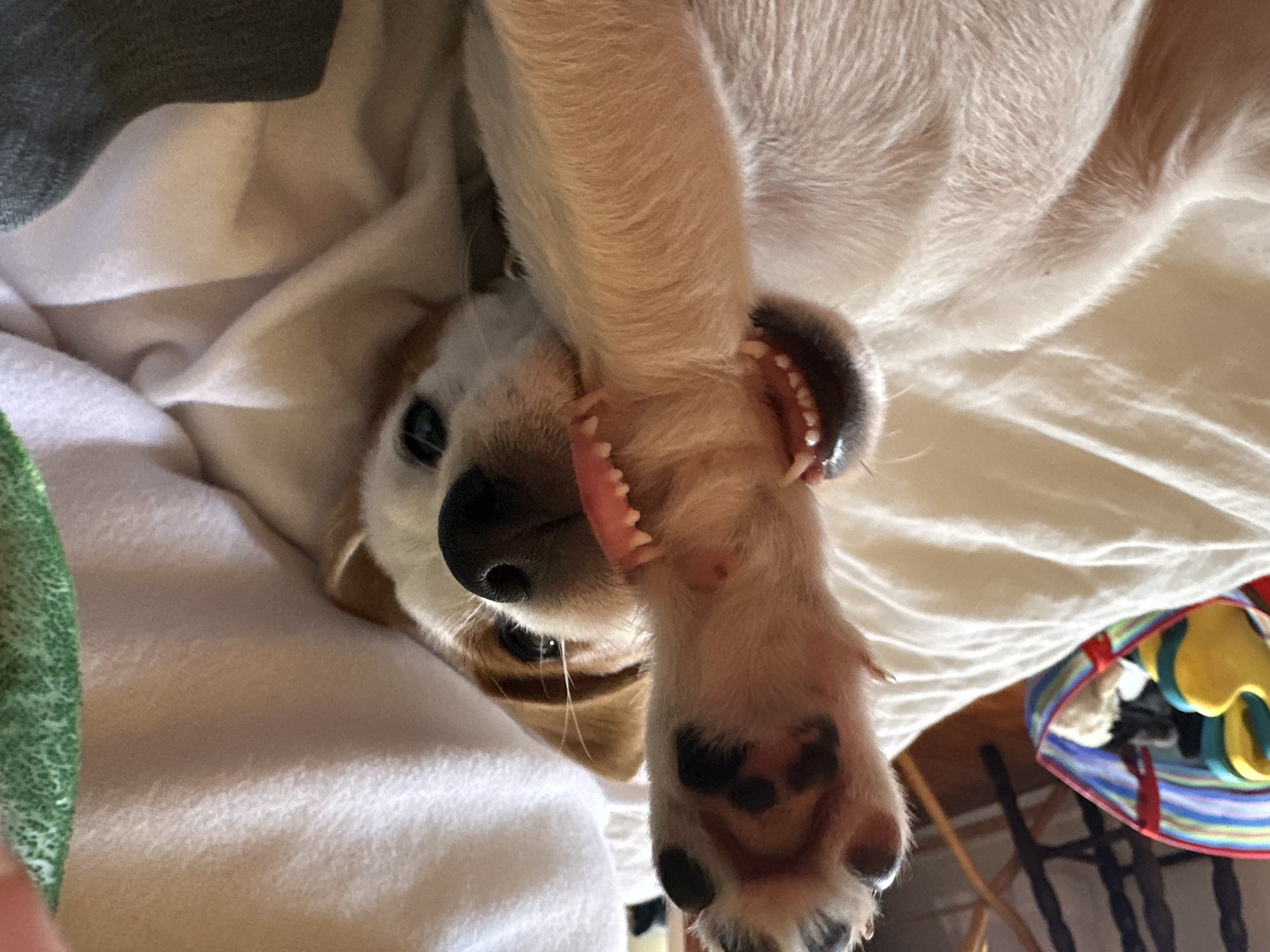
Puppies explore the world with their mouths. This natural behavior, which combines mouthing and teething, can involve nipping, chewing, and play biting. While it might feel frustrating for owners with sore hands and holey clothes, it’s essential to puppy development.
But here’s the critical thing we might not realize: a puppy's mouth — including their teeth and jaw — changes dramatically as they move from baby teeth toward adult teeth, starting around 16 weeks. Younger puppies with smaller bodies and weaker jaws are less likely to cause serious injuries. As their physical capabilities grow, so does the risk, especially if bite inhibition hasn’t been well learned yet.
Here’s a closer look:
- Baby Teeth (Deciduous Teeth)
In the early weeks, puppies have sharp but relatively small, weaker teeth. This is the perfect time to teach bite inhibition because puppies at this stage can safely play and use their mouths without typically causing serious harm to their humans or another pup. The bites can be painful — think nasty paper cut or bad blood draw — but they’re usually surface-level rather than deep damage. - Adult Canines and a Stronger Jaw
Around 4–5 months (roughly 16–20 weeks), adult teeth begin to erupt and jaw strength increases. Without proper bite inhibition training, even a young adolescent dog can cause unintentional but more serious injuries during play. The behavior might feel the same to them — a quick grab, a frustrated snap — but now they have the hardware to bruise, break skin, or worse. They just wouldn’t know any better.
This is a big part of why we don’t treat a 5–6 month-old “big puppy” the same way we treat a 10-week-old baby dog in off-leash play.
Mouthing vs. biting: What’s the difference?
It’s important to understand the difference between mouthing and biting.
Mouthing typically involves softer bites used to explore their world — just like babies and toddlers use their hands and mouths to explore. When a puppy gently nibbles on your fingers during play, that’s mouthing. It’s normal, expected, and part of how they learn.
Biting, on the other hand, usually shows up when a puppy is:
- overstimulated
- frustrated
- scared
- exhausted
These bites are often faster, harder, and more focused. You might see snapping, grabbing clothing, or clamping down. That’s not a “naughty” puppy; that’s a puppy whose coping skills are tapped out.
To prevent these moments, puppies need a schedule that supports their nervous system:
- plenty of rest (young puppies need around 18–20 hours of sleep a day)
- short, predictable play sessions
- lots of chances to succeed rather than hit their breaking point
Puppy bites vs. adult dog bites
Puppy teeth really hurt. They’re like little needles, and a puppy bite often feels like a bad paper cut or an awful blood draw — sharp, stingy, and absolutely capable of making you yelp.
But most puppy bites, in normal play or handling, are surface-level injuries: painful and annoying, but usually not deep tissue damage.
An adult dog (or older adolescent) without acquired bite inhibition (ABI) is a different story. With adult teeth and a much stronger jaw, the same emotional moment — surprise, frustration, over-arousal — can produce a bite that:
- leaves deep bruises
- tears skin
- or causes more serious injury
That’s why we care so much about bite inhibition in the early months. We’re not only protecting your hands today; we’re training a soft mouth before your dog has full adult strength.
The benefits of bite inhibition training before 16 weeks
Bite inhibition is a critical skill learned during early socialization. By the time your puppy is heading toward adolescence, we want to see a clear trend toward softer, more controlled mouth use.
Puppies learn this skill best in well-managed play:
- When a puppy bites too hard, play pauses or stops.
- When they use a softer mouth, play continues.
That clean, consistent feedback teaches them how much pressure is “okay.” It’s a bit like kids learning how to roughhouse without actually hurting each other.
Bite inhibition training before (and around) 16 weeks:
- Promotes positive socialization.
Puppies learn appropriate play behavior and how to read other dogs’ signals. When one pup bites too hard, their playmate yelps or disengages — and that gives immediate information: “too much, try softer.” - Reduces the risk of future injury.
Even a playful dog can cause real pain without bite inhibition. Teaching a soft mouth early helps ensure that if your dog ever does bite out of fear or pain later in life, they’re far more likely to bite with reduced force.
Why we’re cautious about wide “puppy” age ranges
You’ll sometimes see classes marketed as “puppy social” for dogs from 8 weeks all the way up to 6 months. That sounds convenient, but developmentally it’s a problem.
A very young puppy (8–16 weeks) is in their primary socialization period. Their brain is wired to soak up safe, gentle experiences and build “this world is predictable and okay” associations.
By 5–6 months, that same dog is sliding into adolescence. Now the brain is shifting toward:
- testing boundaries
- taking more risks
- handling bigger emotions and possibly hormones
Both stages are normal, but they are not the same job description. Baby brains need gentle, confidence-building play. Teen brains need more structure, coaching, and impulse-control work.
You can think of it this way: a classroom that mixes toddlers and middle-schoolers and calls it a “kids play group” would raise eyebrows. The same logic applies to dogs.
💡 Puppy age ranges matter
You’ll sometimes see classes marketed as “puppy social” for dogs from 8 weeks all the way up to 6 months. That sounds convenient, but developmentally it’s a problem. A 2.5-month-old in their primary socialization period and a 6-month-old adolescent with adult teeth, a much stronger body, and a very different brain do not belong in the same off-leash play group. The risk isn’t that the older dog is “mean” — it’s that normal adolescent roughhousing can physically and emotionally overwhelm a much younger puppy. For early socialization, age-matched groups within the 3–16 week window are the welfare-friendlier choice.
At SmartyPup!, we cap our true puppy classes at the younger ages on purpose. It keeps play safer, learning cleaner, and experiences positive for all puppies in the room.
What happens after 16 weeks? Hello, teenage dog.
Graduating from Puppy 1 doesn’t mean the work is done — it just means your puppy is about to roll into their version of middle school.
Most dogs hit adolescence somewhere between 6 and 18 months, depending on size and breed. In this stage, you may see:
- big feelings about small things (the trash can is suddenly suspicious)
- a “second fear period,” where familiar things briefly feel scary again
- more impulsive choices — jumping, mouthing, door dashing, selective hearing
This isn’t your dog being “stubborn” or “dominant.” It’s their nervous system rewiring, with hormones onboard. Think of adolescence as a remodel of the puppy brain, not a moral failure.
The good news?
All the work you did before and around 16 weeks — bite inhibition, safe dog-dog play, positive associations with people and environments — pays off now. A puppy who learned to use their mouth softly and recover quickly from new experiences is much better equipped to ride out the teenage phase without tipping into fear or aggression.
In our follow-up classes for older puppies and adolescents, we build on that foundation with:
- more impulse-control games (coming away from exciting things, settling in public)
- support through normal “teenage” worry phases
- continued, age-appropriate social contact with other dogs
So yes, the 8–16 week window matters tremendously. It’s not the whole story, but it makes the rest of the story much easier to write.
Importance of early training with SmartyPup!
Starting socialization and training early, especially in the 8 to 14-week window, offers long-term benefits. The sooner you can guide your puppy to become a well-adjusted, confident, and safe companion, the happier you both will be.
In SmartyPup! Puppy 1, we focus on:
- bite inhibition and appropriate mouth use
- safe, coached play with other puppies
- social interaction norms with people and dogs
- foundational skills for everyday life
Early training with SmartyPup! helps reduce the risk of future behavioral problems like fear-based reactions or aggressive responses. We can’t control everything your dog will ever experience, but we can give their brain an outstanding early education.
Missed the cutoff? Don’t panic.
If your puppy has aged out of true baby puppy class, you haven’t “ruined” anything.
That’s why we offer Puppy 1 – Catch-Up: an opportunity for older puppies to get essential training and socialization in an environment designed for their developing bodies and brains.
The guiding principle is simple:
- Reinforcement drives behavior.
- Emotional safety drives learning.
We’ll protect both — for your puppy, and for everyone they meet.